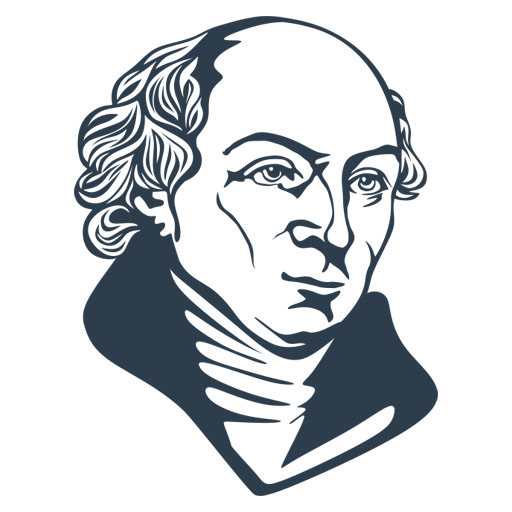
William Carey Missions is named after the famous English missionary preacher William Carey. This is not because William thought so highly of himself — far from it. William Carey was a humble man. Before he became a preacher and missionary, he was a shoemaker. That is why he always still called himself a shoemaker, reminding himself of his humble origins. Despite his humility, William was a passionate man, a visionary with a great longing to make the Gospel known to the unreached. God used him to pass on his passion to others as well. He was remarkable, because God used him in a remarkable way to exert an influence on present-day mission work that continues to this day. A short life story:
Birth and youth
On Monday, 17 August 1761, a little boy was born in the hamlet of Pury End in Paulerspury, Northamptonshire, England, into the family of Edmund and Elizabeth Carey. He was a special boy, although his parents were of course not yet aware of that at the time. God had a great plan for his life. Edmund and Elizabeth named their first child William. Edmund and Elizabeth led a simple existence in the small village. They were weavers by trade. After William, four more children were born into the family.
William grew up in a devout family belonging to the Anglican Church. When William was about six years old, his father was appointed as parish clerk and village schoolmaster — an important and prominent position in the village. It soon became clear that William was remarkably intelligent. He had a great interest in nature, especially in flowers and plants. He also had a great gift for languages, and even taught himself Latin. His gift for languages was clearly a gift from God. Later he would learn to speak and write many more languages, and his gift would be used to translate the Bible into various languages.
Studies
Studying at a university, however, was not an option for William. Bread had to be put on the table. So his father sent him to the village of Piddington to work there as an apprentice to a shoemaker, Clarke Nichols. Clarke was likewise a member of the Anglican Church. But William was not Clarke's only apprentice. Another apprentice was active in the workshop, John Warr. John was no longer a member of the Anglican Church, but a so-called Dissenter, a member of a separatist congregation that disagreed with the prevailing doctrine of the Anglican Church. John had a great influence on William's thinking — so much so that William later also chose to leave the Anglican Church to form a small house congregation in nearby Hackleton.
While William acquired the skills of a shoemaker during the week and by day, he studied further in his scarce free time. He studied classical Greek with a local craftsman, Thomas Jones. Thomas had studied classical languages, and William now benefited from that.
William marries
In 1779, when William was 18 years old, his master Clarke died. Carey got a new employer, Thomas Old. A short time later, Thomas was not only William's employer but also his father-in-law. William married Thomas's daughter, Dorothy Placket. Unlike William, Dorothy could not read or write. In 1781, when William was 20 years old, the couple married in the Church of St John the Baptist in Piddington.
William and Dorothy went to live in Piddington, and William took over his father-in-law's business. During that time William also taught himself Hebrew, Italian, Dutch and French. Together William and Dorothy had seven children — five sons and two daughters. Sorrow, however, was not spared the young couple. Infant mortality was high in those days, and William's family did not escape it. William and Dorothy's two daughters died in childhood, as did their son Peter, who reached only five years of age.
William became involved with a local congregation of Particular Baptists, a separatist denomination that had recently been formed. The Particular Baptists combined a Reformed, Calvinist theology with believer's baptism. There, among the Particular Baptists, William became acquainted with well-known preachers such as John Ryland, John Sutcliff and Andrew Fuller. In later years they would become very good friends. William's new friends invited him to preach every other Sunday in their church in the nearby village of Earls Barton. On 5 October 1783, William Carey was baptized by Rev. John Ryland. He threw himself enthusiastically into the work of the Particular Baptist congregations.
Missionary calling
When William was 24 years old (in 1785), he was appointed schoolmaster in the village of Moulton. He was also called to serve as preacher of the local Particular Baptist congregation. During the time William served that congregation, he read the book by Jonathan Edwards about the life of the missionary David Brainerd. He also read the journals of the explorer James Cook. He was powerfully moved by what he read, and as a result developed a deep commitment to spreading the Gospel throughout the whole world. Carey's great inspirations became David Brainerd and also John Eliot, a Puritan missionary who worked in America.
Struggle for the truth
At a time when hyper-Calvinism was strongly on the rise in England, William began to draw attention to the missionary calling that lay before the Christian church. Hyper-Calvinism is a theological movement that places such strong emphasis on election that the open proclamation of the Gospel scarcely finds a place in preaching anymore — let alone any attention for missions or evangelism. It was a bold and revolutionary attempt by William to urge his contemporaries toward mission work.
But the struggle against the ecclesiastical climate of his time was heavy and stubborn. William's position was not shared. When he was given the floor during a meeting of ministers in Northampton in 1786, he asked for attention to be given to the missionary calling. He asked whether the command given to the apostles to teach all nations was not also the duty of every minister until the end of the world. His proposition caused great consternation. Eventually he was openly rebuked by Rev. John Ryland, with the famous words: “Young man, sit down; when God pleases to convert the heathen, He will do it without your help or mine.” He added that William was a “miserable enthusiast.”
The Enquiry
Two years later William became full-time pastor of the Harvey Lane Baptist Church in Leicester. When he had been pastor of that congregation for three years, he published a highly influential document — a manifesto, a small booklet in which he set out, effectively and with careful argument, the necessity of mission work. The title of the work was: An Enquiry into the Obligations of Christians to use Means for the Conversion of the Heathens (an inquiry into the obligation of Christians to use means for the conversion of the heathen). The booklet consists of five parts:
The first part is a theological foundation for mission work. The main argument William puts forward in this chapter is that the command of the Lord Jesus in Matthew 28:18-20 is still fully in force today — that it is the task of the Christian church to make disciples of the whole world (Teach all nations).
The second part is a summary of the missionary activity of the Christian church. William begins with the commission given by the Lord Jesus Himself, and then shows, by tracing the activities of the apostles and the early church all the way to the missionaries David Brainerd and John Wesley, that the church has always had mission as its task and still needs to fulfil it.
Part three contains an analysis of the state of the world and its inhabitants. It includes a summary of the world population at that time and the people groups known up to that point, together with land area, population composition, and the main religion. William gathered these figures during his years as a schoolteacher in Moulton.
The fourth part answers objections to sending out missionaries, such as the risks involved, which could even cost lives. He also discusses the difficulty of coming to know another language or culture.
In the fifth part, William calls for the formation of a mission organization to take up the missionary task in a concrete way. In it, William describes the practical means needed in order to carry out mission work.
William's groundbreaking manifesto outlines his foundation for missions: the Christian duty to proclaim the Gospel, the wise use of the means available, and the careful gathering of information about the people groups to be reached.
The Deathless Sermon
On 30 May 1792, in the Friar Lane Baptist Chapel in Nottingham, William Carey preached on the necessity of missions to a gathering of fellow ministers. His text was taken from Isaiah 54:2-3. There it reads (KJV): Enlarge the place of thy tent, and let them stretch forth the curtains of thine habitations: spare not, lengthen thy cords, and strengthen thy stakes; For thou shalt break forth on the right hand and on the left; and thy seed shall inherit the Gentiles, and make the desolate cities to be inhabited.
It was a robust and well-founded plea for mission work. Unfortunately, no written version of the sermon is known to exist. Fellow ministers of Carey from that time who were present at the service have described the two main points of the sermon as follows: Expect great things, attempt great things. Later this became Carey's best-known saying: Expect great things from God, attempt great things for God.
Although his listeners were not immediately moved by the sermon, it ultimately proved highly influential. It was this sermon that served as the impetus for a new mission movement and eventually led to the founding of the “Particular Baptist Society for Propagating the Gospel to the Heathen” (later renamed the Baptist Missionary Society). Carey put into practice what he himself preached. He himself was the first missionary preacher to be sent out by the mission organization.
The founding of the mission organization
William was used to finally overcome the resistance to carrying out the missionary calling. William's dream came true. Even John Ryland, who had so openly rebuked William, changed his mind. In October 1792, the Particular Baptist Society for the Propagation of the Gospel Among the Heathen was founded. Its name reflects its purpose: a society of Baptists devoted to proclaiming the Gospel among the heathen. Its board consisted of William Carey, Andrew Fuller, John Ryland and John Sutcliff. Together they focused on practical matters, such as raising funds, and also on determining a mission field. That was ultimately chosen based on a combination of circumstances. They met a missionary doctor, Dr. John Thomas, who had been in Calcutta and was now in England raising funds. The board decided to support John Thomas, and that William would be sent out with him to India.